
Joe and I, in Vermont to visit family during the holiday, spent two afternoons exploring Burlington’s award-winning Church Street Marketplace, a charming, sophisticated four-block long pedestrian mall crammed with over 100 quaint shops, boutiques, cafes, cosmopolitan restaurants and bustling pubs.
This shopper’s delight also features a huge indoor mall. Only after entering is the layout (mostly below ground) revealed.
Tree-lined Church Street (with a classic, steepled New England church anchoring one end) is paved with brick. Aha! That’s why the Mall’s big trees, wearing white lights, are doing well; rainwater is available.
Three immense granite boulders up and down the street are climbing magnets for children; adults, taking advantage of their natural indentations, pause to sit awhile. Attractive streetlamps complete the picture. Side streets (akin to Union and Cass Streets here in Traverse City) allow motorists to bisect the Marketplace between blocks. Cars proceed slowly because pedestrians, crossing over as they please, always have the right-of-way.
Ohmygosh! Ben and Jerry’s original ice cream shop! Though it was 18 degrees outside the generously windowed store was packed with enthusiasts. Amazing!
Knowing they had created a really cool product the two friends opened exactly here in the late 70s: the rest is sweet success.
What’s the best scoop? For one special day every spring shoppers enjoy free cones!
Clever city planners have installed Plexiglas®-covered ‘roofs,’ which slant down from each shop’s regular roof to terminate at pillars. Shoppers are protected from weather; natural light still floods the shops’ entrances.
Oboyo! We found an Irish pub, complete with wooden floors. A lovely 100% genuine Irish lassie took our lunch orders.
The gorgeous Green Mountains offer champion skiing, while Lake Champlain, two blocks away, might house a monster, Champ, a cousin, perhaps, to Scotland’s legendary Loch Ness monster, Nessie. Both lakes share another interesting feature, which the Paranormal Encyclopedia describes:
"Named for its discoverer, Samuel de Champlain, Lake Champlain is a spectacular hundred-mile-long lake that stretches down from Canada and runs north and south between Vermont and New York, forming a natural border between them. While in some spots the lake reaches a depth of 400 feet, extending 150 yards or more from the shore much of the lake is only 12 to 14 feet deep.
A characteristic trait of long, narrow lakes with deep channels is the seiche. Both Loch Ness and Lake Champlain are endowed with this peculiar feature. A seiche is a perpetual wave in an enclosed body of water, which lies in a geographic area that undergoes severe winters. Changes in spring and autumn temperatures affect the shallow areas of these long lakes more rapidly than they affect the deep channels, causing the deep water to slosh back and forth between the lake's boundaries, like a plucked guitar string. At the surface the seiche in Lake Champlain may be barely a ripple, while below the surface it is usually about 30 feet high, and at times may grow to a height of 300 feet.”
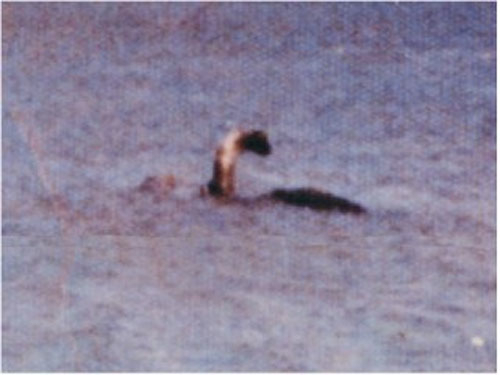
A family snapped a picture of Champ in the 70s that experts have declared genuine. Boat tours hunt this elusive monster (protected by law), whose existence has never been satisfactorily disproven, so bring a camera. It’s a funny old world; you never know… One lucky snap might make you rich.
Addendum:
I must say that, for me, Scotland’s Loch Ness is a decidedly spooky lake, which evokes feelings I still can’t articulate properly. Once, I spent a few days walking the edge, hoping to glimpse its most famous resident. The deep, opaque water was glass-smooth. A ruined castle nearby was partially obscured by mist. Perfect quiet, broken only by my footsteps, contributed to the ambience. (The area is surprisingly underdeveloped.)
One farmer - who’d encountered the monster twice in his long life - was quietly certain about
what
lies
beneath.
This shopper’s delight also features a huge indoor mall. Only after entering is the layout (mostly below ground) revealed.
Tree-lined Church Street (with a classic, steepled New England church anchoring one end) is paved with brick. Aha! That’s why the Mall’s big trees, wearing white lights, are doing well; rainwater is available.
Three immense granite boulders up and down the street are climbing magnets for children; adults, taking advantage of their natural indentations, pause to sit awhile. Attractive streetlamps complete the picture. Side streets (akin to Union and Cass Streets here in Traverse City) allow motorists to bisect the Marketplace between blocks. Cars proceed slowly because pedestrians, crossing over as they please, always have the right-of-way.
Ohmygosh! Ben and Jerry’s original ice cream shop! Though it was 18 degrees outside the generously windowed store was packed with enthusiasts. Amazing!
Knowing they had created a really cool product the two friends opened exactly here in the late 70s: the rest is sweet success.
What’s the best scoop? For one special day every spring shoppers enjoy free cones!
Clever city planners have installed Plexiglas®-covered ‘roofs,’ which slant down from each shop’s regular roof to terminate at pillars. Shoppers are protected from weather; natural light still floods the shops’ entrances.
Oboyo! We found an Irish pub, complete with wooden floors. A lovely 100% genuine Irish lassie took our lunch orders.
The gorgeous Green Mountains offer champion skiing, while Lake Champlain, two blocks away, might house a monster, Champ, a cousin, perhaps, to Scotland’s legendary Loch Ness monster, Nessie. Both lakes share another interesting feature, which the Paranormal Encyclopedia describes:
"Named for its discoverer, Samuel de Champlain, Lake Champlain is a spectacular hundred-mile-long lake that stretches down from Canada and runs north and south between Vermont and New York, forming a natural border between them. While in some spots the lake reaches a depth of 400 feet, extending 150 yards or more from the shore much of the lake is only 12 to 14 feet deep.
A characteristic trait of long, narrow lakes with deep channels is the seiche. Both Loch Ness and Lake Champlain are endowed with this peculiar feature. A seiche is a perpetual wave in an enclosed body of water, which lies in a geographic area that undergoes severe winters. Changes in spring and autumn temperatures affect the shallow areas of these long lakes more rapidly than they affect the deep channels, causing the deep water to slosh back and forth between the lake's boundaries, like a plucked guitar string. At the surface the seiche in Lake Champlain may be barely a ripple, while below the surface it is usually about 30 feet high, and at times may grow to a height of 300 feet.”
A family snapped a picture of Champ in the 70s that experts have declared genuine. Boat tours hunt this elusive monster (protected by law), whose existence has never been satisfactorily disproven, so bring a camera. It’s a funny old world; you never know… One lucky snap might make you rich.
Addendum:
I must say that, for me, Scotland’s Loch Ness is a decidedly spooky lake, which evokes feelings I still can’t articulate properly. Once, I spent a few days walking the edge, hoping to glimpse its most famous resident. The deep, opaque water was glass-smooth. A ruined castle nearby was partially obscured by mist. Perfect quiet, broken only by my footsteps, contributed to the ambience. (The area is surprisingly underdeveloped.)
One farmer - who’d encountered the monster twice in his long life - was quietly certain about
what
lies
beneath.